
Working Paper
You’re still the operating system.
How to recognize concentrated operating judgment before it turns into a permanent escalation pattern—and give the next decision path a durable home.
The warning sign is not that people need help. It is that every important product, technical, and delivery question needs the same person to connect the context before the work can move. The calendar fills with reasonable requests, but the person holding the work together becomes the unspoken operating system.
A familiar week: the work keeps finding the same person
It does not usually present as one dramatic failure. It shows up in small interruptions that all require the same person to translate what one part of the business means to another.
None of those people are necessarily failing. The organization has simply left the essential connections—priority to risk, customer commitment to delivery, decision to owner—in one person’s head.
Illustrative fictional scenario — not a client case study.
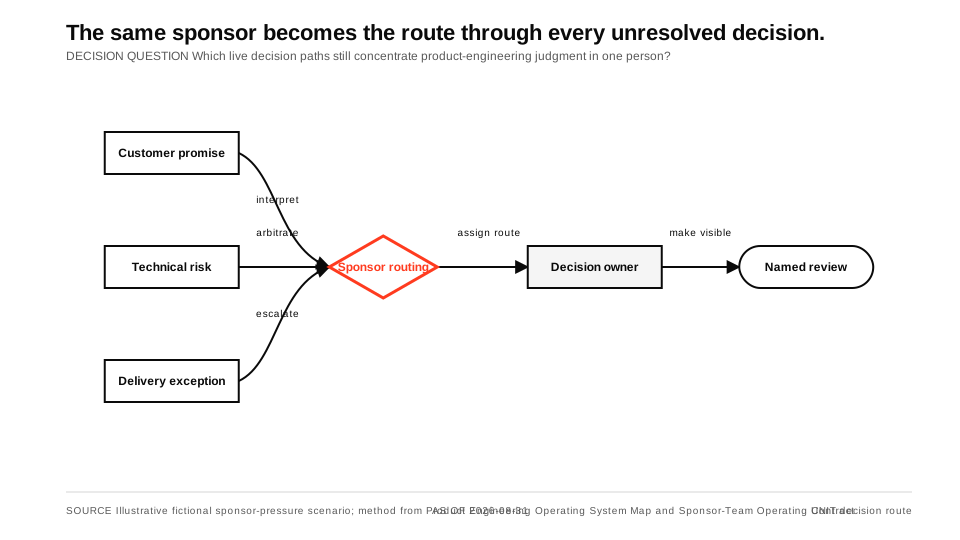
Every unresolved route converges on the sponsor.
The first problem to solve is not a broad organization redesign. It is to make one live decision path, accountable owner, and review point visible enough that the work no longer needs personal routing.
Swipe or scroll to see the full figure
Read the figure as a table
| Route arriving | What is missing | Smallest useful next move |
|---|---|---|
| Customer promise | A visible trade-off between scope, risk, and commitment. | Name the decision owner and decision date. |
| Technical risk | A route from evidence to a product or business choice. | Record the risk, consequence, and escalation condition. |
| Delivery exception | A shared understanding of what will move if priority changes. | Run a short triage with displaced work visible. |
What the pattern looks like
Capable people may be doing solid work. The pressure appears in the gaps between their work: priorities are settled in side conversations, risks surface after a commitment, and a sponsor becomes the default translator between customer, business, product, and engineering concerns.
- Important work waits for one person to make the trade-off legible.
- Escalations are the normal path to coordination.
- Leadership attention substitutes for a visible operating rhythm.
- When that person is unavailable, the work slows or fragments.
Locate the pressure before you add a process
The answer is rarely a bigger process or a new dashboard. The operating-system map is useful here because it gives a sponsor a way to separate different kinds of pressure without turning the organization into a maturity score.
For the scenario above, three cells often matter first. The rest of the map can wait until they change a live decision.
- Execution — Watch: work cannot move predictably because dependencies or sequencing are not being surfaced early enough.
- Ownership — Steer: a decision has no durable home, so it escalates to the sponsor by default.
- Control — Unknown: leadership lacks a small, useful view of what changed, what it means, and whether intervention is needed.
Those are working hypotheses, not a score. They point to the smallest intervention: an owned decision record, a short dependency and risk review, or a sponsor update that contains an outcome, evidence, risk, decision, and next owner instead of task status.
Start smaller than an operating-model rewrite
Choose one live pressure point. Name the outcome, evidence, unresolved uncertainty, accountable owner, and next review. Then add only the mechanism that changes that failure mode. The point is not to perfect the organization. It is to make the next move credible and give the team a way to carry it.
For example: appoint a temporary project tech lead for the technical route of one initiative; use a Decision Ledger for the sponsor choice; or create a two-week triage path for customer requests. Review whether the mechanism reduced personal routing. If it did not, change or retire it rather than layering on another meeting.
What to do in the first week
Do not announce a new operating model. Take one live initiative or recurring escalation and use it to make the invisible routing visible. The first week should produce a better next conversation, not a new reporting burden.
A simple working sequence gives the sponsor a way to stop carrying the whole system alone while preserving the team’s authority over the day-to-day work.
- Day 1 — collect the routes: write down the active customer promise, technical risk, delivery exception, and decision that are currently landing with the same person. Use plain language, not a backlog dump.
- Day 2 — choose one route: bring the sponsor, product partner, and technical lead together long enough to name the outcome, what evidence is missing, what could change the route, and who can make the trade-off.
- Day 3 — give it a durable home: put the decision, owner, review date, and consequence of delay in the team’s normal tool. The record does not need to be polished; it needs to be findable and owned.
- Day 5 — close the loop: tell the affected people what was decided, what work moved or did not move, who owns the next step, and when the route will be reviewed again.
If a live safety, security, service, or data incident is causing material harm, use the established incident process first. This is for the operating ambiguity that keeps turning normal decisions into personal escalations.
Use the resource
Concentrated operating judgment scan
A client-neutral scan for locating where strategy, execution, quality, ownership, growth, or control still depend on one person. It is a conversation aid, not a maturity score or a people-performance record.
PDF for printing or sharing. DOCX for adapting in your own tools.
Choose the next move that matches the situation
Keep working on it yourself
Use the project tech lead guide when one initiative needs a temporary technical ownership role with clear boundaries and an end condition.
Read the project tech lead guideThe constraint crosses teams
Use an Operating Diagnostic when the pressure spans priorities, technical risk, delivery, ownership, and sponsor visibility.
Discuss an Operating DiagnosticYou are still the operating system