
Teams & ownership · Practice guide
Lead the technical route.
Use the role to make a consequential initiative technically coherent and easier to steer. Do not use it as a vague substitute for management, product ownership, or a career decision.
Cross-cutting work often fails in the space between a plan and the engineering choices needed to make it real. A project tech lead can close that gap when the mandate is specific, the decision rights are clear, and the role has an end.
Appoint the role for a problem, not a person
A project tech lead is useful when one initiative needs a coherent technical route through meaningful uncertainty: an architecture choice, a system boundary, a migration, reliability work, an external integration, or a dependency-heavy product bet. The role exists to help the team make and communicate the technical decisions that change delivery.
- The work crosses contributors or teams and needs a single technical narrative.
- Important technical trade-offs need to be surfaced early enough to affect product, scope, or sequencing.
- The engineering manager needs a partner focused on the initiative’s technical route, not another direct report to manage.
- There is a named point at which the role can rotate, narrow, or end.
Give the lead a one-page mandate
The mandate is a working agreement, not a job description. It should be easy for every person on the initiative to scan, question, and revise as the work changes.
A worked example: one initiative, three connected streams
Consider an initiative that changes a customer-facing workflow, introduces a new service boundary, and depends on a platform team. The engineering manager owns staffing, work health, and delivery conditions. The product partner owns the customer problem, evidence, and scope choices. The project tech lead owns the technical route: how the streams fit together, which interfaces need an early decision, what risks could change the plan, and when the team needs help outside its authority.
The role makes the interfaces and risks legible. It does not make one person responsible for every outcome. That distinction keeps a technical coordination role from becoming a shadow manager, architect-of-record, or permanent escalation funnel.
Illustrative fictional scenario — not a client case study.
The senior engineer is becoming the human router.
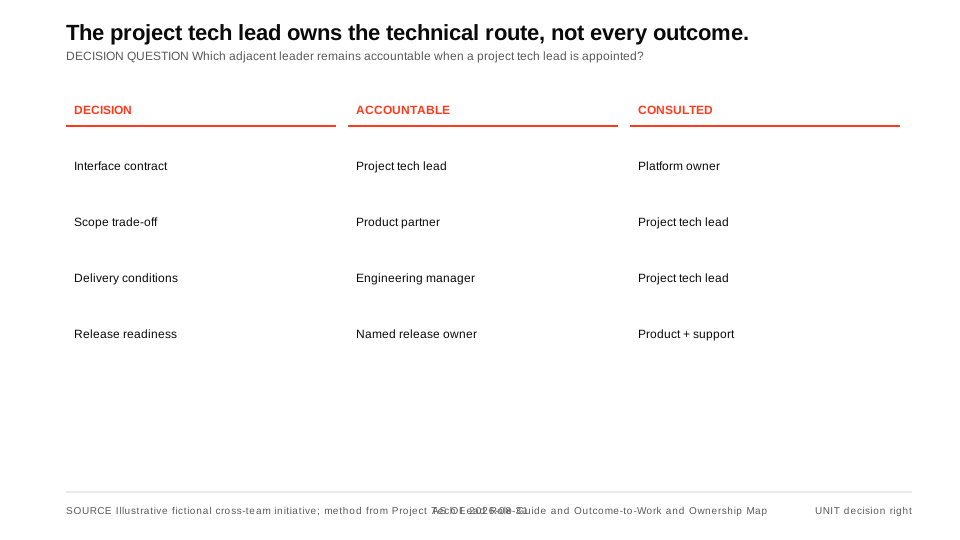
This illustrative initiative has a customer-facing workflow, a platform dependency, and a product scope choice. The project tech lead owns the technical route; adjacent leaders retain their own decisions.
Swipe or scroll to see the full figure
Read the figure as a table
| Decision | Accountable role | Why it stays there |
|---|---|---|
| Interface contract | Project tech lead | It determines the technical route across streams. |
| Scope trade-off | Product partner | It changes customer value and the work to be done. |
| Delivery conditions | Engineering manager | It affects staffing, workload, and team health. |
| Release readiness | Named release owner | It needs an explicit production and customer-facing response path. |
Keep adjacent ownership visible
The role works because it gives a team a clear technical center of gravity. It becomes harmful when it quietly absorbs every other form of leadership. The relevant partners should stay accountable for their own parts of the system.
- Project tech lead: technical route, key trade-offs, integration coherence, technical risk, and an intelligible plan.
- Engineering manager: staffing, workload, delivery health, coaching, and the conditions in which contributors can do the work.
- Product partner: customer problem, value, scope choices, validation, and product acceptance.
- Sponsor or leadership group: material trade-offs, capacity, commitments, and interventions outside the team’s authority.
Choose for the work, then support the person
The right project tech lead is not automatically the most senior engineer, the loudest person in a planning meeting, or the person most likely to accept extra work. Look for someone who can make trade-offs intelligible, invite challenge, connect detail to the outcome, and ask for a decision before the team is boxed in. The mandate should include time and support; it should not be an invisible addition to an already full role.
- Share the mandate with the people who will rely on it and ask what authority or boundary is missing.
- Pair the lead with the engineering manager and product partner for the first risk and decision review.
- Give the lead a way to surface uncertainty without being judged for creating delay or drama.
- Review the role itself after the first material milestone: keep it, narrow it, rotate it, or end it.
Formal titles, compensation, promotion criteria, and employment decisions remain separate from this temporary operating role. If the work reveals a persistent leadership or leveling gap, use the organization’s own people process rather than letting an initiative-specific mandate become a backdoor career system.
In the first risk review, the lead should be able to say: “Here is the interface decision that changes the route; here is the evidence we still need; here is the person who can make the business trade-off.” If they cannot, the mandate is still too vague. Fix the working agreement before asking the lead to absorb the ambiguity personally.
Run a small cadence around what can change the work
The project tech lead does not need a ceremony for every task. A short weekly review with the engineering manager and product partner can be enough: what changed, which risk or dependency needs attention, what decision is coming, and whether the ownership map still fits. Bring a sponsor in only when the team needs a decision or intervention it cannot make itself.
The output is a short shared record, not a layer of status reporting: one technical decision or risk, the evidence, the consequences for scope or sequence, the owner, and the next review. That gives leadership something useful to steer while preserving the team’s day-to-day autonomy.
- Review the initiative’s critical unknowns, dependencies, and technical decisions.
- Update the ownership and escalation path when the work crosses a boundary.
- Make trade-offs explicit before they become a delivery surprise.
- Retire meetings and records that no longer change a decision or reduce a risk.
Watch for the role becoming a workaround
If the team keeps inventing special leads because ordinary ownership is unclear, the diagnosis is no longer one initiative. It may be a roles-and-responsibilities, manager-capacity, architecture-governance, or sponsor-steering problem. The right response is to make that broader constraint visible, not to stack more informal roles on top of it.
- The lead becomes the default approver for all technical work, even work outside the initiative.
- The lead is expected to manage performance, staffing, or product priority without the associated mandate.
- The same risk escalates repeatedly because no permanent owner or decision right was established.
- The role has no review point, end condition, or shared account of what it is meant to solve.
Retire the role on purpose
When the technical route is established, ownership is distributed, and the remaining work is normal team execution, the role should shrink or end. That is not a failure. It is evidence that the initiative no longer needs a special operating intervention. Career progression, title, compensation, and formal people processes remain separate decisions under the organization’s own policies.
Use the resource
Project tech lead appointment sheet
A client-neutral sheet for naming the initiative, delegated authority, partner roles, risk review, escalation route, and a condition for retiring or rotating the role.
PDF for printing or sharing. DOCX for adapting in your own tools.
Choose the next move that matches the situation
Keep working on it yourself
Use the recognition guide to test whether a temporary role is enough or whether operating judgment is still concentrating in the wrong place.
Read the recognition guideA single ownership question
Bring a live mandate, authority boundary, or cross-team decision to a Working Session when the right next move is unclear.
Bring it to a Working SessionOwnership keeps collapsing upward